Sunday, July 14, 2019

Box 3: Zeno, Infinity and Beyond!

The ancient Greek philosopher Zeno of Elea is famous for his paradoxes concerning motion.  They are perhaps best explained in videos:

1.  Achilles and the Tortoise


 2.  The Dicotomy


3.  The Arrow


4.  The Stadium or the Moving Rows


Zeno's paradoxes were disturbing and the Greeks took them as a warning of the dangers inherent in exploring the idea of infinity.  That road seemed to lead to absurdity and madness!  Brian Clegg in his wonderful Introducing Infinity:  A Graphical Guide mulls over...


  In fact many historians of mathematics say that Zeno curbed the development of mathematics by discouraging Greek mathematicians from using ideas of infinite series to discover the calculus.  As Carl Boyer notes in his History of Calculus and its Conceptual Development: 

The inability of Greek mathematicians to answer in a clear manner the paradoxes of Zeno made it necessary for them to forego the attempt to give to the phenomena of motion and variability a quantitative explanation. These experiences were consequently confined to the field of metaphysical speculation, as in the work of Heraclitus, or to that of qualitative description, as the physics of Aristotle. Only the static aspects of optics, mechanics, and astronomy found a place in Greek mathematics, and it remained for the Scholastics and early modern scientists to establish a quantitative dynamics.

An infinite series accumulating to a finite sum seemed counterintuitive, but can be presented in diagrams worth a thousand words, such as in these examples presented by Mr Honner in his Math Appreciation blog:


It was not until the the 16th century that the mathematicians Isaac Newton and Gottfried Wilhelm Leibniz began using with a vengence their infinitely small numbers called infinitesimals and in so doing invented the infinitely powerful tool called the calculus.

Their infinitesimals were open to ridicule, such as by the philosopher Bishop George Berkeley who would have gladly locked them back in Zeno's Paradox Box.  Berkeley published a work entitled:

 The AnalystA DISCOURSE Addressed to an Infidel MATHEMATICIAN. WHEREIN It is examined whether the Object, Principles, and Inferences of the modern Analysis are more distinctly conceived, or more evidently deduced, than Religious Mysteries and Points of Faith.

A famous quote from this work attacking those detestable infinitesimals:

And what are these Fluxions? The Velocities of evanescent Increments? And what are these same evanescent Increments? They are neither finite Quantities nor Quantities infinitely small, nor yet nothing. May we not call them the ghosts of departed quantities?

Those dreaded ghosts of departed quantities continued to haunt mathematicians until finally in the nineteenth century they believed that they had finally exorcised them from calculus.  In the twentieth century calculus was taught using the limit concept and infinitesimals seemed finally to be safely banished and boxed away in their own teeny, tiny hell.

But in the 1960s, a mathematician and logician Abraham Robinson famously demonstrated once and for all that infinitesimals can be made logically rigorous and were not much worse an abstraction that the square root of -1.  Robinson began the development of Non-Standard Analysis


 Non-Standard Analysis uses some weirdly unreal numbers called Hyperreal Numbers and this approach has  been found to improve and simplify some diabolically difficult procedures in calculus, as well as leading to such amusing offshoots as






Friday, July 12, 2019

Index of Past Posts


Mathematics has an amazing ability to escape Houdini-like from any box it gets put into, and so doing develops whole new techniques, whole new fields of inquiry.  This blog explores mathematics as the art and science of thinking outside the box.  In this exploration, we shall look at several of the "boxes" that attempted to enclose areas of mathematics, and we shall see how mathematics escaped each box and grew more and more powerful in the process!

 Here is an expanded index of past posts. We are always revisiting and revising these posts, seeking to add more information on each subject:


Box 1:   Pandora's Box  (Pythagoras and the Natural Numbers)

Box 2:   Curved Space?  (Euclidean Geometry)

Box 3:   Zeno, Infinity and Beyond!  (Zeno's Paradoxes) 

Box 9:   Cadmus and Harmonia  (Analytical or Co-ordinate Geometry) 

Box 10:   Heat Wave  (Fourier Analysis) 

Box 11:   Artists and Mapmakers  (Projective Geometry) 

Box 12:   Descent Into Chaos  (Fractals and the Mandelbrot Set) 

Box 13:   Gambler's Blues  (Probability Theory) 

Box 14:   Napier's Bones  (Logarithms) 

Box 15:   The Game of Life  (Cellular Automata) 


PDF Versions of the above posts:

The free online site Printfriendly provides a quick and easy way to convert blog posts and other web pages into PDF files for downloading.  I have converted all the above posts to PDFs and they are available here:


These PDFs are also available as a single PDF document merged by the free online service PDF24 Tools:


Thursday, July 11, 2019

Box 2: Curved Space?

Euclidean Geometry is the great example of how to present ideas in a logical framework that Aristotle would approve of:  you start from intuitive notions that anyone would accept, along with some definitions and then show how further ideas are based on these and can be logically deduced from these initial assumptions.  

 Isaac Newton applied the Euclidean logical model to physics in his magnum opus, the Principia Mathematica.  Colin Pask, in his book Magnificent Principia: Exploring Isaac Newton's Masterpiece pays homage to Euclid and his influence:

Euclid's Elements is the first great mathematics book. It is an enduring masterpiece, going through more editions than any book except the Bible. The development of geometry that it presents remains valid today. There are three reasons for the enormous influence of the Elements. First, it shows us how a subject may be developed on the basis of definitions, axioms, and logical rules for working. Euclid provided a model for use in other fields. Second, it gave us the first systematic approach to a branch of mathematics—geometry in a plane and in three dimensions—as well as certain aspects of number theory.
The third thing Euclid gave us is an accurate and consistent piece of theoretical physics, the first such work, according to Einstein.

In the 17th century, both Spinoza and Newton followed Euclid in his logical mode.

Spinoza applied this model to philosophy, structuring his Ethics in a Euclidean manner as explained by the great 20th century mathematican and philosopher Bertrand Russell in his History of Western Philosophy:

The Ethics is set forth in the style of Euclid, with definitions, axioms, and theorems; everything after the axioms is supposed to be rigorously demonstrated by deductive argument... But it would show a lack of understanding to blame Spinoza for his geometrical method. It was of the essence of his system, ethically as well as metaphysically, to maintain that everything could be demonstrated, and it was therefore essential to produce demonstrations. We cannot accept his method, but that is because we cannot accept his metaphysic. We cannot believe that the interconnections of the parts of the universe are logical, because we hold that scientific laws are to be discovered by observation, not by reasoning alone. But for Spinoza the geometrical method was necessary, and was bound up with the most essential parts of his doctrine.


So the influence of Euclidean Geometry has been enormous, but it is important to remember that Euclid's system was a way of organizing and logically proving geometrical ideas that were already known, and did NOT provide a way of mechanically grinding out new theorems or developing new geometries.  

It now even seems likely that the 18th Century philosopher Immanuel Kant was right to suggest that Euclidean Geometry was in some sense hard-wired into our brains and our way of perceiving space.  This does NOT mean, however, that space is necessarily Euclidean, only that we perceive it in a Euclidean way.  So mathematicians began to wonder if in fact space was Euclidean or rather something else!

One particular postulate or first principle in Euclid's Elements seemed different from the rest.  It was the fifth postulate, also known as the parallel postulate:

If a line segment intersects two straight lines forming two interior angles on the same side that sum to less than two right angles, then the two lines, if extended indefinitely, meet on that side on which the angles sum to less than two right angles.

Many mathematicians believed that this postulate should be a deduction from the other postulates, but no one was able to provide such a deduction.

So geometry was confined for centuries in the Euclidean box until finally, early in the 19th century, a few mathematicians thought about what would happen if you rejected this postulate and said for example:  

There are no parallel straight lines. Every straight line intersects every other straight line at two points.

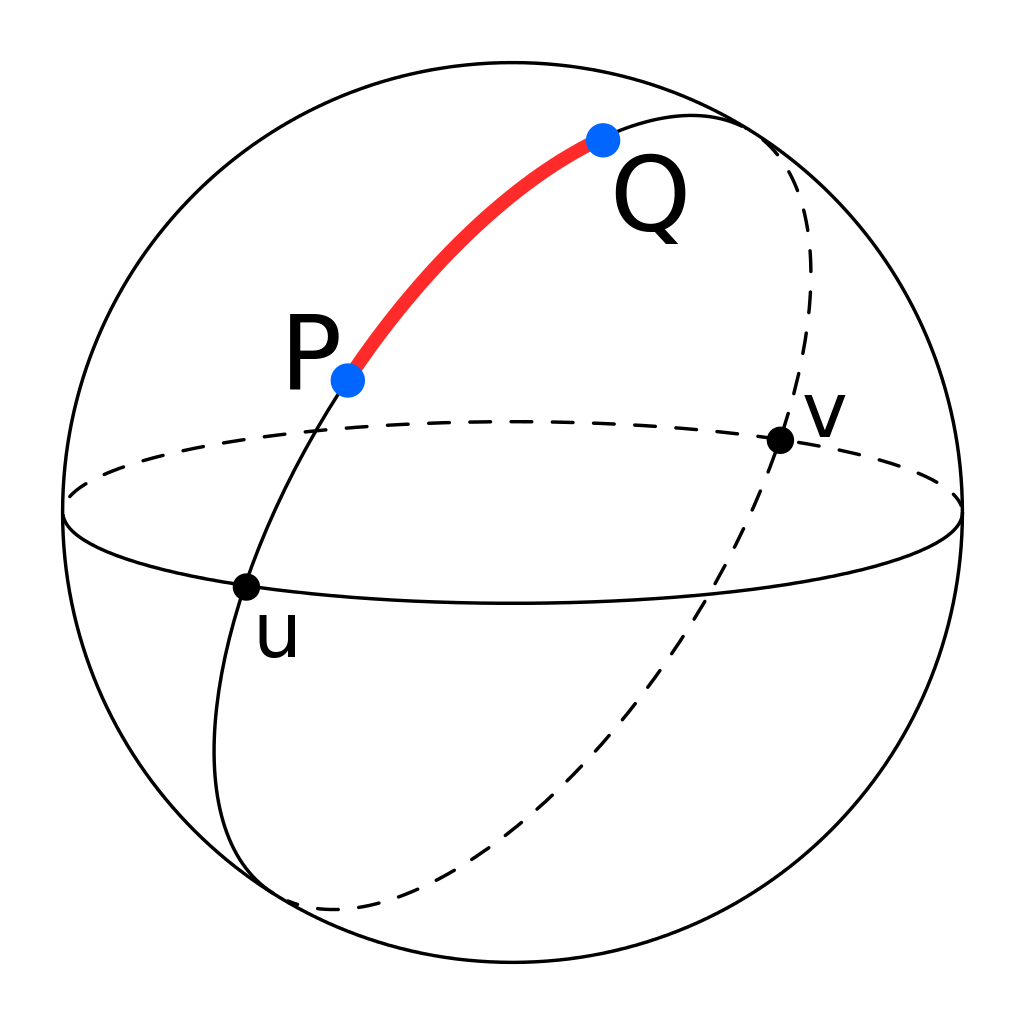
From a Euclidean point of view this sounds like utter nonsense, but in fact it is the basis of spherical geometry or the geometry of our planet's surface!  If we define a straight line as the shortest distance between two points, then on the surface of a sphere or on the surface of the Earth, "straight lines" are in fact "great circles" like the equator that are on a plane with the center of the Earth and always intersect each other:

 Spherical geometry explains why it is actually a shorter route for a jet to swing north when flying from North America to Europe.  On a flat map this would be a longer route, but on a globe it is actually the shorter route!

This means that the shortest path between Los Angeles and London on Earth’s map is not a straight line (red), but rather a curve (purple) that follows a line on the sphere that is Earth. Spheres and Such: How do people use Spherical Geometry?


The mind bending thing is to move from the surface of the Earth to a consideration of spherical space!  This is difficult for our Euclidean brains to conceive, but it is something that mathematicians can do by just adding another variable, so instead of spherical geometry of a two dimensional plane such as the surface of the Earth, we consider spherical geometry of three dimensional space and imagine the Universe as finite:  Your spaceship can fly off in one direction and (like someone going around the world) end up where you started from!
 
And so at the beginning of the 19th century, Non-Euclidean Geometry was born.  It was first explored independently by several mathematicians: the Germans Carl Friedrich Gauss and Ferdinand Karl Schweikart , the Hungarian János Bolyai , and the Russian  Nikolai Ivanovich Lobachevsky

Bernhard Riemann developed his Non-Euclidean Riemann Geometry that led in turn to the study of curved space and the development of tools such as the tensor calculus which Einstein used in his Theory of General Relativity to present gravitation geometrically as a bending of space rather than as Newtonian action at a distance.

 Some entertaining videos on Non-Euclidean Geometry:


Sunday, July 7, 2019

Box 1: Pandora's Box

Introduction

Mathematics has an amazing ability to escape Houdini-like from any box it gets put into, and so doing develops whole new techniques, whole new fields of inquiry.  This blog explores mathematics as the art and science of thinking outside the box.  In this exploration, we shall look at several of the "boxes" that attempted to enclose areas of mathematics, and we shall see how mathematics escaped each box and grew more and more powerful in the process!

As the great mathematician James Joseph Sylvester noted:


Box 1:  Pythagoras and the Natural Numbers

 Pythagoras of Samos


Pythagoras believed that "all is number" and is credited with discovering the mathematical basis of music harmony:  that notes that sound well together were found at intervals that could be expressed in ratios of natural or counting numbers.


According to Iamblichus, Pythagoras made an important discovery after observing that the hammers being used by blacksmiths in town made a ringing sound when striking iron. He realized that the weight of two hammers bore a simple numerical relationship to each other.

If the weight of two hammers were in ratio to each other, they were harmonious. If the hammers didn’t have a simple weight ratio in common, when they struck the iron, the sounds weren’t harmonious. This story is considered influential because it demonstrates an important relationship between music and math.

The finding is that tones with low-integer relationships are harmonious and thus pleasing to the human ear.


Being an avid lyre player, Pythagoras could see how this discovery also applied to the lengths of plucked strings and many other musical instruments:

Woodcut showing Pythagoras with hammers, bells, a kind of glass harmonica, a monochord and (organ?) pipes in Pythagorean tuning. From Theorica musicae by Franchino Gaffurio, 1492 (1480?)  This image comes from Gallica Digital Library and is available under the digital ID bpt6k58171q.f36

The History of Music Theory website has an excellent page devoted to Pythagoras and his contributions to music theory:


It seemed common sense that the natural numbers were all the numbers that were required, since you could get as big a natural number as you wished (eg. 1,345,678,900) or invert it to get as small a number as you would ever want (eg. 1/1,345,678,900).

But when the Pythagoreans used their famous theorem to find the length of the diagonal of a square


they found it to be the square root of 2, but then discovered that this number could NOT be expressed as the ratio of two natural numbers.  Some credit the Pythagorean named Hippasus with proving the square root of 2 was IRRATIONAL.  He cleverly used an indirect proof by contradiction, or reductio ad absurdum.  For this method of proof you begin by assuming that there is a ratio of natural numbers p/q that is equal to the square root of 2 and then show that this assumption leads to a contradiction.   This proof rocked the foundation of the Pythagorean faith in the natural numbers, and legend has it that other Pythagoreans had Hippasus drowned so that irrational numbers would remain unknown:


What are irrational numbers anyway and do we really need them?


An entertaining look at proving the square root of 2 is irrational:


Are there other ways to prove that the square root of 2 is irrational?


A fascinating visualization of irrational numbers:


With numbers behaving in such an irrational manner, Greek mathematicians changed their focus to geometry.  Geometers could easily construct line segments of irrational length, even if they were incommeasurable with other lines of rational length.  

 As Wikiwand explains:


Irrational numbers remained troublesome and controversial.  Even as late as the 19th century, the great German mathematician Leopold Kronecker was eager to banish them and put mathematics back in the Pythagorean Box:


"Interestingly, the topics Kronecker studied were restricted by the fact that he believed in the reduction of all mathematics to arguments involving only the integers and a finite number of steps. Kronecker believed that mathematics should deal only with finite numbers and with a finite number of operations. He was the first to doubt the significance of non-constructive existence proofs. It appears that, from the early 1870s, Kronecker was opposed to the use of irrational numbers, upper and lower limits, and the Bolzano-Weierstrass theorem, because of their non-constructive nature. Another consequence of his philosophy of mathematics was that to Kronecker transcendental numbers could not exist."

- from web page on Kronecker:  God made the integers, all the rest is the work of man – Leopold Kronecker 


But Pandora's Box was now opened and could not be closed even to please the great Kronecker. 

From the cover of Brian Bolt's great collection of math puzzles:

A Mathematical Pandora's Box

 Even more exotic and provocative numbers would be found that would further enrage the followers of Finitism, but keep mathematicians entranced and excited for eons to come!  We shall deal with more of them in future posts.

John Conway playing the Game of Life in 1974. Kelvin Brodie, The Sun News Syndication The great 20th century mathematician John von N...